Hello Friends,
Namaste! I hope you and your family are doing well. Today, I want to sit down and talk about something that is very close to the heart of every common man in India—something that ensures no one sleeps hungry. We are talking about the Antyodaya Anna Yojana 2026 (AAY) . As we look towards 2026, this scheme remains the backbone of food security for the poorest families. I will try to explain everything in simple words, just like a friend explaining it to you over a cup of tea.
What is Antyodaya Anna Yojana?
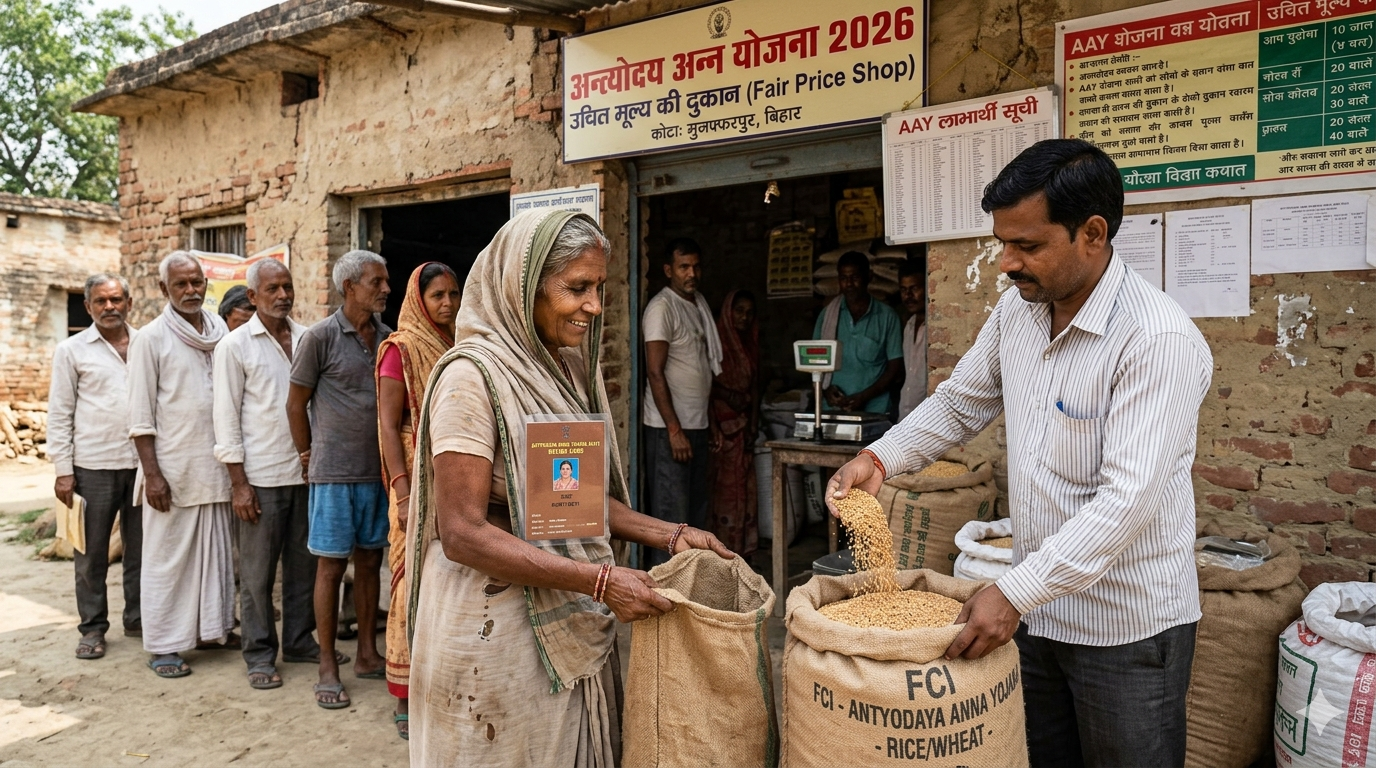
When I first heard about this scheme, I thought, “Who does the government actually want to help?” The name itself, Antyodaya Anna Yojana 2026, means “uplifting the last man.” It was launched back on 1st May 2001 with a clear mission: to target the poorest of the poor households.
In very simple language, this is not a scheme for everyone. It is specially designed for those families who sometimes struggle to get two meals a day. The government identified that in a big country like ours, some people need extra support, and AAY is the answer to that need.
Do you know its very special and unique? Unlike general ration cards, the AAY card is a symbol of the government’s commitment to those who have no regular income, no stable job, and often no one else to support them.
Who is Eligible?
This is the most important part. When I was reading about the scheme, I found that the government has been very clear about who gets this benefit. According to the official guidelines, priority is given to households that are often ignored by mainstream society.
Here is the list of who qualifies:
- Households headed by widows or terminally ill persons.
- Families with disabled persons or persons aged 60 years or more.
- Single women or single men with no assured means of subsistence.
- All Primitive Tribal Households.
- Landless agricultural laborers, marginal farmers, rural artisans (like potters, weavers, blacksmiths).
- Slum dwellers and people earning daily wages like porters, rickshaw pullers, rag pickers, and cobblers.
I remember meeting a rickshaw puller in my neighborhood, Ramesh bhai. He once told me, “Saheb, if there’s a day it rains, my earning stops. But because of this AAY card, at least my family has roti.” That is the reality. This scheme catches those who fall through the cracks of the regular system.
The Benefits: What Do You Get?
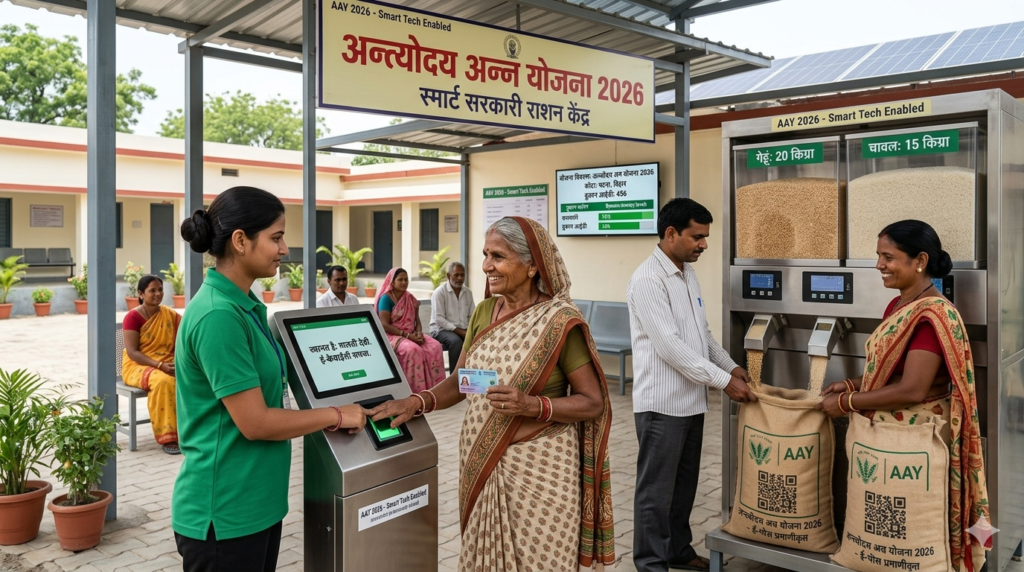
Let’s talk numbers because that’s what matters at the end of the day. Under the Antyodaya Anna Yojana, the basic facility is very simple: 35 Kg of Food-grain per month.
Resent Post: Rashtriya Fiber Yojana 2026:
Resent Post: MGNREGA Explained: India’s Biggest Rural Employment.
Now, here is a massive update for 2026. While earlier the wheat was given at Rs. 2 per kg and rice at Rs. 3 per kg, the current scenario under the National Food Security Act ensures that these 35 kilograms are provided free of cost. Just imagine—35 kg of wheat or rice for a family, absolutely free, every single month.
So friend, let’s know something more interesting about this feature. Do you know why it’s fixed at 35 kg? It is designed to be a full meal basket for a family of five for a month. It’s not just a handout; it’s a safety net that allows families to spend their hard-earned money on medicine, education, or saving for a rainy day instead of worrying about food.
Here is a quick overview of the benefits in a simple table:
| Feature | Details |
| Scheme Name | Antyodaya Anna Yojana (AAY) |
| Launched On | 1st May 2001 |
| Target Beneficiaries | Poorest of the Poor (Widows, Disabled, Elderly, Landless Laborers, etc.) |
| Food Grains Provided | Wheat & Rice |
| Quantity | 35 Kg per month (per family) |
| Current Cost | Free of Cost (under NFSA) |
How to Apply for the AAY Ration Card?
If you or someone you know fits the criteria above, the process is not as complicated as people think. The government has tried to make it accessible.
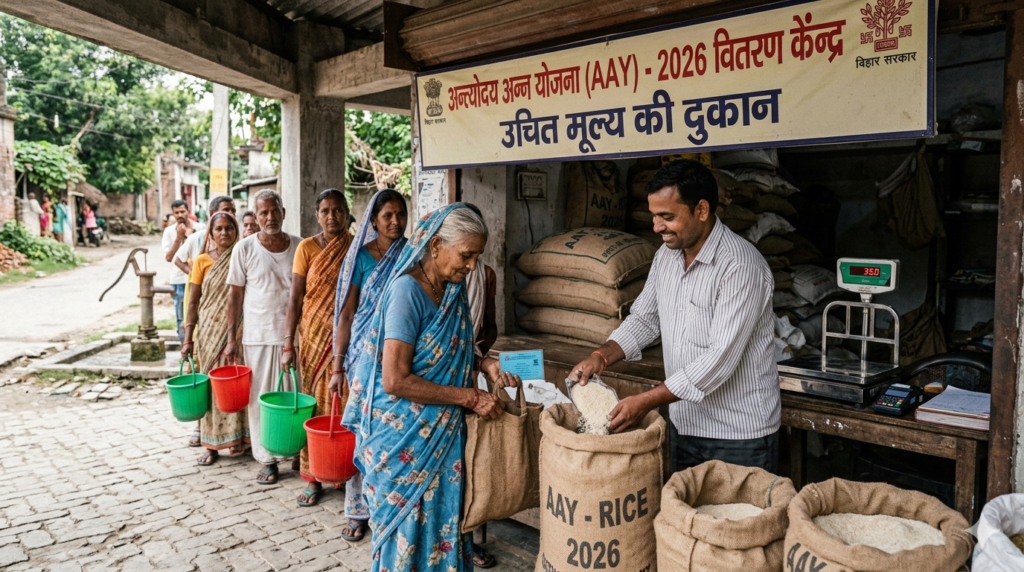
In my opinion, the easiest way is to visit your nearby Rationing Office. You can also apply through the Ration Card Management System. Usually, the process involves filling out a simple form and providing proof of your status (like a BPL certificate or proof of being a landless laborer).
So brother, lets know something interesting about the application. The Government of India has specifically instructed officers to prioritize HIV/AIDS affected persons and Leprosy affected persons who fall under the BPL lists. This is a unique feature because it shows that the scheme is sensitive to those facing social stigma. Do you know its very special? It ensures that even if a family is facing health crises, they don’t have to face hunger.
My Personal Take: Why This Scheme Matters
When I look at the Antyodaya Anna Yojana 2026, I see more than just a government scheme. I see dignity.
A few years back, I visited a village in the outskirts. I met an elderly woman, about 70 years old, who lived alone. Her husband had passed away, and her children had moved to the city. She had no source of income. She showed me her AAY card. She said, “Beta, this card is my son. The government gives me my 35 kg of rice. I cook two meals a day, and I don’t have to beg anyone.”
That moment stayed with me. In a country of 140 crore people, it is easy to feel lost. But schemes like this ensure that the poorest households—those headed by widows, the disabled, or the elderly—are not forgotten.
In 2026, as we talk about development and technology, I hope we never forget the importance of this scheme. It is the foundation of our society. It ensures that the last man in the line gets his share before the first man finishes the meal.
Here are the FAQs:
1. Who is eligible for the AAY card?
The poorest of the poor families—households headed by widows, elderly persons (60+), disabled individuals, landless agricultural laborers, daily wage workers (rickshaw pullers, porters, rag pickers), and primitive tribal households.
2. How much food grain does a family receive?
35 kg per month of wheat and rice. Currently, this is provided free of cost under the National Food Security Act.
3. How can someone apply for the AAY ration card?
Visit the nearest Rationing Office in your area or apply online through the Ration Card Management System available on your state’s food department website.
4. What is the difference between AAY and a regular BPL card?
AAY is specifically for the poorest among BPL families. AAY cardholders receive 35 kg of grain monthly, while regular BPL cardholders typically receive a smaller quantity.
5. Is there special priority for certain groups?
Yes. HIV/AIDS affected persons and leprosy affected persons who are already in BPL lists receive special priority under this scheme.


Leave a Comment